Fire stopping between floors
The floor is usually the strongest fire line in a building, until a riser is cut through it.
- Every seal labelled and photographed
- BM TRADA / FIRAS-certificated contractors
- Written price before any work
In a concrete-framed building the floor slab is a fire barrier by default. It only stops being one where something has been cut through it. That means service risers, mostly, and the cupboards where the electrics, water and data go up from the basement to the roof.
The trouble with a riser is that nobody owns it. The electrician pulls new cables and leaves the hole a bit bigger. The broadband installer drills a fresh one. Ten years on the floor of the cupboard has five or six openings, some with foam in them and some with nothing.
Two ways to close a riser
The first is to seal at every floor. Each slab opening is closed round its services with batt, mastic, collars and wraps as needed, so each floor of the riser is its own box. That is the usual answer in a block of flats.
The second is to treat the whole riser as a fire-resisting shaft, with fire-rated walls and doors on every floor, and only seal where services leave it. That is a design decision, so it should match the building's fire strategy. If nobody knows which approach the building was designed for, a survey finds out what is there now.
Slab edges
The other route up a building is the edge of the floor, where it meets the outside wall. In some blocks there is a gap there that runs the whole width of the building. That is a cavity barrier and curtain wall question, and it often needs opening up to see.
A real one
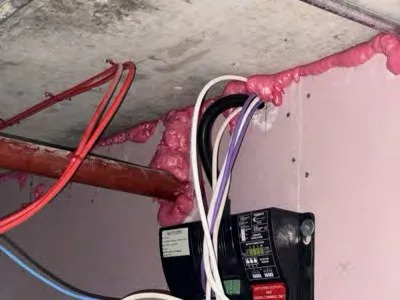
The photo here shows pink foam pushed round a red pipe and a group of cables at the head of a wall. That kind of work is common in risers. It needs cutting out before a tested seal goes in. The sealing is done by our BM TRADA / FIRAS-certificated contractors, and each opening gets a number, a label and a photo.
Send the postcode and a photo with a tape measure in shot. We will tell you what it needs and what it is likely to cost.